Category: Blog
Your blog category
-
Restricted content
Sorry. This Post is Restricted to Approved Family Members and Friends. -
The Rohan Family Legacy
The Rohan Family and the Sychrov Estate in Bohemia: A History, 1660-1830
I. Introduction: The Rohans and Sychrov in Historical Context
(c. 1660-1830)
A. Overview
B. Setting the Scene: Bohemia and France (1660)
The year 1660 found Bohemia and France on markedly different trajectories, shaped by the preceding decades. Bohemia, a kingdom within the Holy Roman Empire, was still grappling with the aftermath of the devastating Thirty Years’ War (1618-1648). The Peace of Westphalia (1648) had solidified Habsburg control over the kingdom, ensuring its place within the Austrian Habsburg Monarchy. The decisive Battle of White Mountain (1620) had led to the suppression of the Protestant Bohemian estates, large-scale confiscation of their lands, and the emigration of many Protestant nobles and commoners. This period saw the rigorous enforcement of the Counter-Reformation, consolidating Catholic authority and reshaping the Bohemian nobility through the introduction of loyal, often foreign, Catholic families rewarded with confiscated lands. While stability gradually returned under Habsburg rule, the kingdom was focused on recovery and integration into the centralized structures of the monarchy.
In contrast, 1660 marked the ascent of Louis XIV’s personal rule in France. The French monarchy was consolidating its power, epitomized by the burgeoning court society centered at Versailles. Great aristocratic families like the Rohans navigated the complex hierarchies and patronage networks of the court, their status and influence intrinsically tied to royal favor and prestigious appointments. France was emerging as the dominant political and cultural power in Europe, a world away from the post-conflict reconstruction occurring in Bohemia. These divergent contexts form the backdrop against which the histories of the Rohan family and the Sychrov estate unfolded before their eventual intersection in 1820.
C. Scope and Methodology
This report focuses chronologically on the period from 1660 to 1830. It investigates the history of the Sychrov estate and its region in northern Bohemia, including its ownership prior to the Rohans, specifically by the Lamotte de Frintropp and Wallenstein families. It concurrently traces the history of the relevant Rohan-Guéméné lineage, examining their standing and activities in France, the circumstances leading to their exile during the French Revolution, and their subsequent settlement in the Austrian Empire. The analysis culminates with the acquisition of Sychrov by Charles Alain Gabriel de Rohan in 1820 and the family’s initial activities and territorial establishment on the estate up to 1830. The study draws upon available historical documentation and incorporates analysis of relevant historical maps to reconstruct the regional landscape and landholdings.
II. The Sychrov Estate and its Region Before the Rohans (1660-1820)
A. Early History (Pre-1660 Context)
The site upon which Sychrov Castle was later constructed possessed a history extending back well before the 1660 timeframe. Records indicate that a fort existed at this location as early as the 15th century, belonging to the Bohemian royal chamber.1 By the 16th century, this fortification had been replaced by a manor house.1 This establishes the site’s presence within the administrative and proprietary landscape of the Kingdom of Bohemia for centuries prior to the arrival of the families central to this report’s focus period.
B. The Lamotte de Frintropp Era (c. 1690-1740)
The Sychrov estate entered a new phase in the late 17th century with the arrival of the Lamotte de Frintropp family. Between 1690 and 1693, this knightly house constructed a small Baroque chateau on the site of the earlier manor.1 The Lamottes were members of the French aristocracy who had served as army officers for the Austrian Habsburg Emperor during the Thirty Years’ War.1 Their acquisition of Sychrov exemplifies a significant pattern in post-1648 Bohemia. Following the defeat of the Protestant Bohemian estates, the Habsburg monarchy confiscated vast amounts of land and redistributed it to loyal supporters, many of whom were Catholic nobles from other parts of Europe, including France, Germany, and Italy. This policy aimed to consolidate Habsburg power, ensure Catholic dominance, and reshape the Bohemian aristocracy. The Lamottes, rewarded for their military service with property formerly belonging to the Bohemian nobility, were beneficiaries of this broader socio-political transformation.1 Their construction of the Baroque chateau established the core structure that would later be acquired and significantly altered by the Rohan family.
C. The Wallenstein Period (1740-1820)
In 1740, ownership of the Sychrov domain passed to Francis of Wallenstein, a member of the prominent Bohemian aristocratic Wallenstein family, specifically from the Mnichovo Hradiště line.1 The Wallensteins were one of the most powerful and influential families in Bohemia. However, their primary residence was located elsewhere, notably at Mnichovo Hradiště.1 Consequently, for nearly eighty years under Wallenstein ownership, Sychrov ceased to be a continuous aristocratic residence.1 The chateau was relegated to a secondary role, used primarily for technical and operational purposes related to the estate’s management, and for housing service staff.1
This extended period of non-residential use had significant consequences for the property. Lacking the investment and attention typically afforded a primary noble seat, the Baroque chateau gradually fell into a state of disrepair.1 This situation reflects common estate management practices among major aristocratic families who controlled multiple properties, often designating less important holdings for administrative functions rather than lavish upkeep. The resulting “decayed” condition of the Sychrov chateau by 1820 1 directly influenced the Rohan family’s decision to undertake extensive renovations immediately upon acquiring the property.
D. The Sychrov Region (Turnov, Český Dub) & Broader Bohemia (1660-1820)
The period from 1660 to 1820 saw Bohemia firmly entrenched within the Habsburg Monarchy. Following the upheavals of the Thirty Years’ War, the region experienced relative political stability under centralized Habsburg administration. The Counter-Reformation continued to shape religious and cultural life, with Catholicism being the dominant and state-supported faith. The Bohemian nobility, significantly altered by the post-1620 confiscations and influx of loyalist families, became increasingly integrated into the imperial system, holding positions in administration and the military. Bohemia retained its status as a Kingdom (České království) and was formally incorporated into the Austrian Empire upon its proclamation in 1804. Administratively, the kingdom was divided into districts (Kreise); historical maps from the 19th century place the Turnov area within the Gitschin (Jičín) Kreis.
Economically, the region remained predominantly agrarian. The broader European economy experienced difficulties in the latter half of the 17th century, often termed the “Seventeenth-Century Crisis,” which may have impacted Bohemia’s recovery, followed by gradual stabilization and growth in the 18th century. Specific local industries existed, such as the historical tradition of gingerbread in Turnov and gem cutting, for which the town later became famous, though detailed economic data for the Sychrov or Český Dub areas specifically within the 1660-1820 timeframe is limited in the provided sources. The social structure was dominated by the landed aristocracy and the system of serfdom, which bound peasants to the land and subjected them to obligations towards their lords. Serfdom was only abolished later, in 1848. Jewish communities existed in Bohemia, though they faced periods of restriction and expulsion, particularly from royal towns.
The overall picture of the Sychrov region during this era is one of relative stability under Habsburg rule, embedded within a traditional agrarian society governed by feudal relationships. The lack of significant development noted at the Sychrov estate itself under the Wallensteins likely mirrored a broader pattern of slow change in this rural part of Bohemia, contrasting with the dynamism of major urban centers or regions undergoing earlier industrialization. The landscape, as depicted in maps from the period (discussed in Section V), would reflect this agrarian character, with forests, fields, meadows, and small villages clustered around local centers like Turnov.
III. The Rohan-Guéméné Branch: From Versailles to Exile (1660-1820)
A. The House of Rohan-Guéméné: Status and Influence (1660-1780s)
Within the esteemed House of Rohan, the Rohan-Guéméné line held the position of the senior branch. Tracing their ancestry to the medieval Dukes of Brittany, the Rohans possessed immense prestige within the French nobility. By the 17th century, they had successfully asserted their claim to the rank of princes étrangers (Foreign Princes) at the French court. This status, based on their purported descent from sovereign rulers, placed them in the highest echelons of the aristocracy, second only to the princes du sang (Princes of the Blood Royal) and above most dukes and peers. Key titles associated with this branch included Prince de Guéméné and Duc de Montbazon.
This elevated rank translated into significant influence and access to powerful positions at court. The period leading up to the French Revolution saw Henri Louis Marie de Rohan (1745-1809), Prince de Guéméné, appointed as Grand Chamberlain of France in 1775, one of the Great Officers of the Crown. His wife, Victoire Armande Josèphe de Rohan (1743-1807), known as Madame de Guéméné, held the equally prestigious post of Governess of the Children of France, responsible for the upbringing and household of the royal offspring. Earlier members, such as Louis de Rohan-Guéméné, the “Knight of Rohan,” had served as Grand Huntsman of France and Colonel of Louis XIV’s Guards, though his career ended in execution for treason in 1674.
These positions signified immense favor and proximity to the monarchs, Louis XVI and Marie Antoinette. The family resided in splendor at the Hôtel de Rohan-Guéméné on the Place des Vosges in Paris and participated fully in the opulent, demanding, and extremely expensive life of the court at Versailles. The Rohans’ standing was deeply interwoven with the fabric of the Ancien Régime monarchy; their service enhanced the crown’s prestige, while royal patronage conferred upon them the status, titles, and access essential for maintaining their aristocratic power and influence. This symbiotic relationship, however, rendered them particularly vulnerable to shifts in fortune, both the crown’s and their own.
B. Crisis and Emigration (1780s-1791)
The glittering façade of the Rohan-Guéméné’s court life concealed underlying fragility. In 1782, the family was engulfed in a major scandal when Prince Henri Louis declared bankruptcy, his debts amounting to an astonishing 33 million livres. This financial ruin stemmed from a combination of extravagant living, high-stakes gambling (Madame de Guéméné was noted for introducing illegal games with high stakes in her salon), and potentially poor financial management or speculation. The bankruptcy forced the Prince and Princess to resign their coveted court positions. Their valuable properties, including the Hôtel de Rohan-Guéméné, were eventually sold to satisfy creditors.
This financial collapse occurred seven years before the storming of the Bastille, leading to the family’s disgrace and ostracization from court society well before the Revolution fundamentally challenged the aristocratic order.2 The pre-existing financial ruin and social marginalization likely amplified their vulnerability and motivations when the French Revolution erupted in 1789. While the Revolution posed a direct threat to all nobility through political upheaval, violence (especially during the Reign of Terror), and laws targeting émigrés, the Rohan-Guéméné family had already experienced a dramatic fall from grace. Their decision to emigrate was thus driven not only by the general dangers faced by their class but also by a personal history of scandal and loss that had already dismantled their standing within the French system.
In the early years of the Revolution, likely around 1791 3, Henri Louis, Victoire, their surviving children – including the future purchaser of Sychrov, Charles Alain Gabriel – and Henri Louis’s father, Jules Hercule Mériadec, fled France.2
C. Settlement in the Austrian Empire (1791-1820)
Like many French émigrés seeking refuge from the Revolution, the Rohan-Guéméné family made their way to the territories of the Austrian Habsburg Monarchy.2 The Austrian Empire offered relative stability and was a center for counter-revolutionary activity and émigré communities.
The key figure in the family’s Bohemian future was Charles Alain Gabriel de Rohan (1764-1836).1 Born at Versailles, he had married Louise Aglaé de Conflans d’Armentières in Paris in 1781 and emigrated with his parents and siblings.3 Demonstrating a capacity for adaptation, Charles Alain entered the military service of the Austrian Emperor Leopold II and rose through the ranks to become a Field Marshal in the Austrian army.3 This military career was crucial, providing him with a position and status within the Habsburg system and likely facilitating the family’s acceptance and integration into their new environment.
The family eventually settled in Bohemia, then a Crown Land of the Habsburg Monarchy.2 Victoire de Rohan died in 1807 (sources differ on whether she died in Paris after returning or settled in Bohemia). Prince Henri Louis died in Prague in 1809. Charles Alain inherited the title of Prince de Guéméné upon his father’s death. Furthermore, through his paternal grandmother, Marie Louise de La Tour d’Auvergne, Charles Alain became the heir to the claims associated with the Duchy of Bouillon after the death of a distant cousin in 1802.3 This potential inheritance may have bolstered his standing or financial resources.
Unlike many French émigrés who returned to France during Napoleon’s rule or the Bourbon Restoration, Charles Alain and his branch of the Rohan family made the significant decision to remain permanently in Bohemia.1 This choice, coupled with Charles Alain’s successful integration into Austrian military service and his eventual acquisition of a major estate, marked a definitive shift. They transitioned from exiled French courtiers to naturalized Bohemian landowners, embedding themselves within the social and political structure of the Austrian Empire.
IV. The Dawn of the Rohan Era at Sychrov (1820-1830)
A. Acquisition of Sychrov and Svijany
The decisive moment for the establishment of the Rohans in Bohemia came on August 30, 1820. On this date, Duke Charles Alain Gabriel de Rohan purchased the Sychrov estate, along with the nearby domain of Svijany.1 Sychrov was designated as the main seat of this Bohemian branch of the family.1 This acquisition was the culmination of the family’s decision to forgo returning to France and establish a permanent base within the Austrian Empire.1 The need for a residence befitting their princely rank was paramount, as the existing structure at Sychrov was considered inadequate for their requirements.1
B. Initial State of the Property
The property Charles Alain Gabriel acquired consisted of the small Baroque chateau originally built by the Lamotte de Frintropp family between 1690 and 1693.1 After nearly eighty years of serving primarily as an administrative center and staff housing under the Wallensteins, the chateau was described as being in a “decayed” or “dilapidated” state.1 Associated with the chateau were the lands comprising the Sychrov and Svijany domains, including whatever park or garden areas existed at the time.
C. Early Activities (1820-1830): The First Reconstruction
Recognizing the inadequacy of the existing chateau, Charles Alain Gabriel Rohan initiated a significant reconstruction project almost immediately after the purchase in 1820.1 This first phase of renovation, reflecting the prevailing architectural tastes of the era, was executed in the Empire style.1 While the project reached completion in 1834 1, slightly beyond the 1830 scope of this report, the crucial planning and initial construction work occurred within this first decade of Rohan ownership. Concurrently, attention was given to the grounds. The expansion and development of the park likely began during this period, with sources mentioning work starting as early as 1821 under the direction of gardeners such as Pruvot, who had also emigrated from France. Although the famous English-style landscape park is primarily associated with the later Neo-Gothic transformation under Prince Camille Rohan, the foundations for developing the grounds were laid by Charles Alain.
D. Territorial Holdings (1820-1830)
The Rohan acquisition explicitly included the domains of Sychrov and Svijany.1 This purchase represented a substantial investment in land, signaling the family’s intent to establish a significant territorial base in Bohemia. Determining the precise boundaries and total acreage of these holdings during the initial 1820-1830 decade is challenging based solely on the narrative sources. The castle park itself is later described as comprising 23 or 26 hectares, but this figure likely reflects later developments.
The most detailed evidence for the extent of Rohan landownership emerges slightly after this period with the implementation of the Austrian Stable Cadastre (Stabilní katastr). This comprehensive land survey, undertaken for tax purposes, began in Bohemia in 1826 and continued into the early 1840s.4 The cadastral map for Sychrov itself dates from 1843. These large-scale maps (typically 1:2,880 for settled areas) meticulously documented every land parcel, building, owner, and land use type.4 Therefore, the Stable Cadastre maps provide the earliest precise visualization of the Sychrov and Svijany estates under Rohan ownership, delineating the exact parcels of arable land, forest, meadow, and built property that constituted their holdings in the years immediately following 1830.4 While surveyed just after the primary timeframe, they offer the best available proxy for understanding the territorial footprint established during the initial decade. The nearby cadastral area of Paceřice is noted as 349 hectares, though its specific inclusion in the Rohan estate at this time is not confirmed.
The decade from 1820 to 1830 was thus a foundational period for the Rohans at Sychrov. It marked their transition from landless émigrés to established Bohemian proprietors. The acquisition of two domains and the immediate commencement of major reconstruction and park development demonstrated Charles Alain Gabriel de Rohan’s commitment to transforming the neglected estate into a residence worthy of his family’s lineage and newly adopted homeland. This initial phase laid the essential groundwork for the subsequent, more famous, Neo-Gothic transformation that would define Sychrov’s identity.
V. Visualizing the Landscape: Historical Maps of the Sychrov Region (c. 1720-1830)
Historical maps are invaluable tools for understanding the physical and human landscape of the Sychrov region during the 1660-1830 period. Several key cartographic surveys covering Bohemia provide snapshots at different points in time, revealing changes in settlement patterns, land use, infrastructure, and, eventually, the extent of Rohan land ownership.
A. Müller’s Map of Bohemia (1720)
Completed in 1720 by the Austrian military engineer and cartographer Johann Christoph Müller, the Mappa geographica regni Bohemiae is a monumental work of early 18th-century cartography. Produced at a scale of approximately 1:132,000 and printed on 25 sheets, it was the largest and most detailed map of Bohemia created up to that time. It depicts over 15,000 settlements, along with hydrography, vegetation, relief (using pictorial representation), roads, and boundaries. This map represents the Sychrov region during the later years of the Lamotte de Frintropp ownership or the very beginning of the Wallenstein period. Viewing this layer (access may require specific portals or requests 5) would show the location of the small Baroque chateau (if deemed significant enough for inclusion at this scale), nearby towns like Turnov, the network of roads and tracks, forests, and watercourses such as the Jizera River as they existed around 1720. It provides a baseline against which later changes can be measured.
B. First Military Survey (Josephinian Land Survey, 1764-1767 for Bohemia)
Initiated by Empress Maria Theresa, the First Military Survey (Josephinische Landesaufnahme) was the first systematic, comprehensive mapping of the entire Habsburg Monarchy for military purposes. Conducted for Bohemia between 1764 and 1767, the survey produced detailed, hand-drawn, and colored topographic maps at a scale of 1:28,800. The maps emphasized features of military significance: terrain (depicted with hachures), the classification and condition of roads, rivers and streams, forests, fields, meadows, pastures, and individual buildings like churches and mills. Written descriptions often accompanied the maps, providing further details on resources and infrastructure. This survey offers a detailed view of the Sychrov region during the middle of the Wallenstein ownership period, roughly 50-60 years before the Rohans’ arrival. It would show the Baroque chateau, the layout of surrounding villages, patterns of cultivation and forest cover, and the transportation network with much greater precision than Müller’s map.6 It captures the landscape just before the era of major agricultural or industrial change began in many parts of Europe. These maps are accessible through online portals such as Arcanum Maps.6
C. Stable Cadastre (Stabilní katastr, surveyed from 1826 in Bohemia)
The Stable Cadastre represents a shift from topographic to property mapping. Mandated by Emperor Francis I in 1817 for tax assessment purposes, this survey meticulously mapped every land parcel in the empire. The survey of Bohemia took place between 1826 and 1843.4 The resulting maps, typically at a very large scale of 1:2,880 for villages and their immediate surroundings, were produced using lithography and colored to indicate land use. They show the precise boundaries of individual plots, buildings, owners, parcel numbers, and cultivation types. The cadastral map covering Sychrov itself dates from 1843. Although the survey dates extend slightly beyond the 1830 endpoint of this report, the Stable Cadastre maps are the single most important source for visualizing the Sychrov and Svijany domains under early Rohan ownership.4 They provide definitive evidence of the extent and composition of the territory acquired by Charles Alain Gabriel Rohan, showing the estate’s layout after his initial Empire-style reconstructions had begun but before the later Neo-Gothic overhaul. These maps can be viewed via the Czech Office for Surveying, Mapping and Cadastre (ČÚZK) geoportal.4
D. Second Military Survey (Franciscan Survey, 1836-1852 for Bohemia/Moravia)
Brief mention should be made of the Second Military Survey, also known as the Franciscan mapping (Franziszeische Landesaufnahme). Conducted for Bohemia and Moravia between 1836 and 1852 at a scale of 1:28,800, it updated the topographic information from the First Military Survey.7 It shows roads, buildings, natural features, and relief using Lehmann hachures. While largely falling after 1830, this map layer, accessible on platforms like Mapy.cz 7, depicts the Sychrov region after Charles Alain’s death (1836) and during the transition phase before or at the very beginning of the major Neo-Gothic reconstruction under Camille Rohan, providing a valuable link between the earlier surveys and the mid-19th century landscape.
E. Cartographic Insights
Comparing these successive cartographic layers offers a powerful lens through which to observe the evolution of the Sychrov regional landscape over more than a century. The progression from Müller’s 1720 map, through the First Military Survey of the 1760s, to the Stable Cadastre of the 1820s-1840s allows for the tracking of changes – or lack thereof – in settlement patterns, the density and routes of roads, the extent of forests versus agricultural land, and the development of the Sychrov estate itself. This comparison visually corroborates the narrative of Sychrov’s relative stasis under Wallenstein ownership followed by the initial phase of transformation under Charles Alain Rohan. Furthermore, the Stable Cadastre maps are uniquely positioned to answer the query regarding the territory controlled by the Rohans shortly after their arrival. By precisely delineating property boundaries and ownership, these cadastral maps provide the most concrete available evidence of the extent of the Sychrov and Svijany domains as consolidated by the family in the early decades of their Bohemian tenure.
VI. Conclusion: Sychrov and the Rohans at the Cusp of Change (1830)
The period from 1660 to 1830 encompasses distinct chapters in the history of both the Sychrov estate and the Rohan-Guéméné family. Sychrov, initially developed with a modest Baroque chateau by the French émigré Lamotte de Frintropp family in the late 17th century, subsequently spent eighty years as a secondary, largely neglected property under the ownership of the powerful Wallenstein family.1 This occurred within the broader context of Bohemia’s consolidation within the Habsburg Monarchy following the Thirty Years’ War, a period marked by relative stability, Catholic dominance, and the persistence of traditional agrarian social structures.
Concurrently, the Rohan-Guéméné family navigated the heights of French aristocratic society, holding prestigious positions at the court of Versailles. Their status, however, proved precarious, culminating in a devastating bankruptcy scandal in 1782 that preceded the French Revolution. The Revolution itself acted as the final catalyst for their emigration, leading them, like many other nobles, to seek refuge in the Austrian Empire.3 Choosing permanent exile over return, Charles Alain Gabriel de Rohan, leveraging his service in the Austrian military and potential inheritances, acquired the Sychrov and Svijany domains in 1820.1
The decade from 1820 to 1830 marked the crucial initial phase of the Rohan era at Sychrov. Charles Alain Gabriel began the process of transforming the dilapidated estate into a suitable noble residence, initiating an extensive reconstruction in the Empire style and commencing improvements to the park.1 The family firmly established its territorial presence through the ownership of the Sychrov and Svijany domains, the extent of which would be precisely documented by the Stable Cadastre surveys beginning in the late 1820s.4
By 1830, the Rohans were securely established landowners in Bohemia, having successfully transitioned from the pinnacle of French court society through the trauma of revolution and exile. Sychrov was beginning its transformation under their ownership. However, the most defining chapter in the castle’s architectural history – the extensive Neo-Gothic reconstruction undertaken from 1847 by Charles Alain’s successor, Prince Camille Rohan – still lay in the future. The period examined in this report, 1660-1830, thus represents the essential prologue, setting the stage by tracing the distinct histories of the place and the family before their convergence and documenting the foundational first decade of the Rohan presence at Sychrov.
Table 1: Timeline of Key Events Related to Sychrov and the Rohan-Guéméné Branch (1660-1830)
Year(s) Event Location Relevance c. 1660 Start of Report Timeframe Bohemia/France Context setting: Post-Thirty Years’ War Bohemia; Reign of Louis XIV France 1674 Execution of Louis de Rohan-Guéméné (“Knight of Rohan”) Paris Earlier Rohan-Guéméné figure at court 1690-1693 Construction of Baroque Chateau at Sychrov by Lamotte de Frintropp Sychrov, Bohemia Foundation of the later castle structure 1720 Completion of Müller’s Map of Bohemia Bohemia Earliest detailed map showing the region in the period 1740 Francis of Wallenstein purchases Sychrov domain Sychrov, Bohemia Start of 80-year period of secondary use for the estate 1743 Birth of Victoire de Rohan (future Madame de Guéméné) Paris Key figure in Rohan-Guéméné history 1745 Birth of Henri Louis de Rohan (future Prince de Guéméné) Paris Key figure in Rohan-Guéméné history 1761 Marriage of Henri Louis de Rohan and Victoire de Rohan Paris Union of senior (Guéméné) and cadet (Soubise) Rohan branches 1764 Birth of Charles Alain Gabriel de Rohan Versailles Future purchaser of Sychrov 1764-1767 First Military Survey conducted for Bohemia Bohemia Detailed map showing Sychrov region under Wallenstein ownership 1775 Henri Louis appointed Grand Chamberlain; Victoire appointed Governess of Children of France Versailles Peak of Rohan-Guéméné influence at court 1781 Marriage of Charles Alain Gabriel de Rohan and Louise Aglaé de Conflans d’Armentières Paris Marriage of the future Sychrov owner 1782 Bankruptcy of Prince Henri Louis de Rohan; resignation from court posts Paris/Versailles Major scandal leading to financial ruin and social decline 1789 Start of the French Revolution France Catalyst for aristocratic emigration c. 1791 Emigration of Rohan-Guéméné family (Henri Louis, Victoire, Charles Alain, etc.) from France France Flight to escape the Revolution 1791 onwards Charles Alain Gabriel de Rohan serves in the Austrian Army, rises to Field Marshal Austrian Empire Integration into Habsburg system 1802 Death of Duke of Bouillon; Charles Alain becomes heir to claim via grandmother — Potential impact on status/finances 1804 Proclamation of the Austrian Empire (incorporating Bohemia) Austrian Empire Formal political context for Rohan settlement 1806 Dissolution of the Holy Roman Empire — End of Bohemia’s status within the HRE 1807 Death of Victoire de Rohan (Madame de Guéméné) Paris/Bohemia? Death of key family matriarch 1809 Death of Henri Louis, Prince de Guéméné Prague Death of key family patriarch; Charles Alain inherits Guéméné title 1820 (Aug 30) Charles Alain Gabriel de Rohan purchases Sychrov and Svijany domains Sychrov, Bohemia Beginning of the Rohan era at Sychrov c. 1820/1821 Start of Empire-style reconstruction of Sychrov Chateau; start of park development Sychrov, Bohemia Initial transformation of the estate under Rohan ownership 1826 Start of Stable Cadastral survey in Bohemia Bohemia Mapping that would precisely document Rohan landholdings 1830 End of Report Timeframe Sychrov, Bohemia Rohans established; initial reconstruction ongoing; major changes yet to come Works cited
- History – Sychrov, accessed April 23, 2025, https://www.zamek-sychrov.cz/en/about/history
- Sychrov Chateau – Elegance in Exile – Beyond Prague, accessed April 23, 2025, https://beyondprague.net/chateaus/sychrov-chateau-elegance-in-exile/
- Charles Alain, Prince of Guéméné – Wikipedia, accessed April 23, 2025, https://en.wikipedia.org/wiki/Charles_Alain,_Prince_of_Gu%C3%A9m%C3%A9n%C3%A9
- Císařské povinné otisky stabilního katastru 1:2 … – ČÚZK: Geoportál, accessed April 23, 2025, https://geoportal.cuzk.cz/(S(2xvncvprfrj2t2n5ffpc1dkh))/Default.aspx?mode=TextMeta&side=dSady_archiv&metadataID=CZ-CUZK-COC-R&head_tab=sekce-02-gp&menu=2901
- Müller’s map of Bohemia from 1720 – ČÚZK: Geoportál, accessed April 23, 2025, https://geoportal.cuzk.cz/(S(2uk4xkplfu54q5nkpgwaxrri))/Default.aspx?lng=EN&mode=TextMeta&side=mapy_tiskKHM&metadataID=CZ-CUZK-MULLER_CECHY-T
- Königreich Böhmen (1764–1767) – First Military Survey | Arcanum …, accessed April 23, 2025, https://maps.arcanum.com/en/map/firstsurvey-bohemia/
- Map Types – Help Mapy.com, accessed April 23, 2025, https://napoveda.seznam.cz/en/maps/map-types/archive-map-19th-century19th-century/
-
Sychrov Castle: A Journey Through Time
I. Introduction
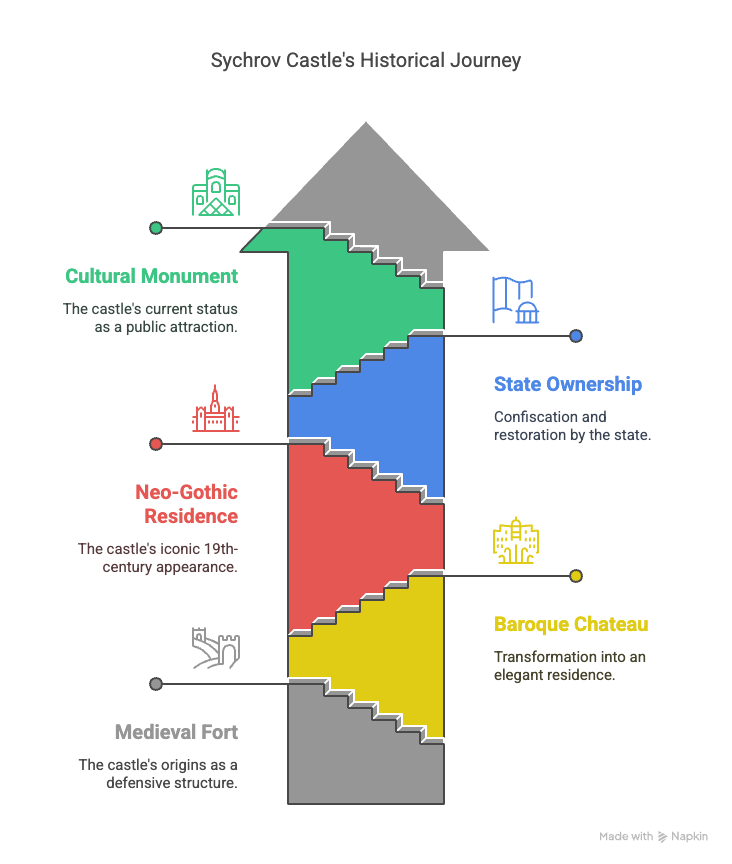
Nestled in the scenic Bohemian Paradise region of the Czech Republic, Sychrov Castle stands as a remarkable testament to centuries of history and architectural evolution.1 Primarily renowned today for its striking Neo-Gothic appearance, a legacy of the French Rohan nobility who made it their home in exile, the castle’s story stretches back much further.5 From a medieval fort to a Baroque chateau, and finally to the romantic 19th-century residence seen today, Sychrov has witnessed the rise and fall of noble families and the sweep of European history.5 Confiscated by the state after World War II, it has since been meticulously restored and is now a national cultural monument, welcoming visitors to explore its opulent interiors, extensive park, and rich past.5
II. Early Foundations: From Fort to Manor (15th – 17th Centuries)
The history of settlement at the Sychrov site dates back centuries before the current structure took shape. As early as the 15th century, records indicate the existence of a fort at this location, belonging to the Bohemian royal chamber.5 This early fortification, originally part of the Svojkov estate, underscores the site’s long-standing presence within the administrative landscape of the Kingdom of Bohemia.4 By the 16th century, this fort had been replaced by a stone manor house, marking the transition towards a more residential function.5 The estate passed through the hands of several owners during this period, eventually being destroyed during the tumultuous Thirty Years’ War.18
III. The Baroque Era: The Lamotte de Frintropp Chateau (1690-1740)
Following the devastation of the Thirty Years’ War, the Sychrov estate entered a new phase. Between 1690 and 1693, the knightly house of Lamotte de Frintropp constructed a small, two-story Baroque chateau on the site of the earlier manor house.5 The Lamottes were members of the French aristocracy who had served as army officers for the Austrian Habsburg Emperor during the war.5 Their acquisition of Sychrov exemplifies a significant pattern in post-1648 Bohemia, where the Habsburg monarchy redistributed lands confiscated from the Bohemian aristocracy to loyal supporters, often foreign Catholic nobles.5 The Lamottes’ Baroque chateau, complete with a high tower, chapel, and ornamental garden, established the core structure that would later be transformed by the Rohan family.9
IV. A Period of Stasis: Wallenstein Ownership (1740-1820)
In 1740, ownership of the Sychrov domain passed to Francis of Wallenstein, a member of the prominent Bohemian aristocratic Wallenstein family, specifically from the Mnichovo Hradiště line.5 The Wallensteins, one of Bohemia’s most powerful families, already possessed significant estates, with their primary residence located elsewhere (Mnichovo Hradiště).5 Consequently, for the nearly eighty years under Wallenstein ownership, Sychrov ceased to be a continuous aristocratic residence.5 The chateau was relegated to a secondary role, used primarily for administrative and operational purposes related to the estate’s management and for housing service staff.5 Lacking the investment and attention afforded a primary noble seat, the Baroque structure gradually fell into disrepair, described as “decayed” or “dilapidated” by the time it was sold in 1820.5
V. The Rohan Era: Exile, Acquisition, and Transformation (1820-1945)
The arrival of the Rohan family marked the most significant and defining period in Sychrov’s history.5
A. From Versailles to Bohemia
The House of Rohan was one of France’s oldest and most influential noble families, originating in Brittany and claiming descent from its medieval rulers.5 By the 18th century, the senior Rohan-Guéméné branch held prestigious positions at the French court, such as Grand Chamberlain of France (Henri Louis de Rohan) and Governess of the Children of France (his wife, Victoire de Rohan).1 However, extravagant living and financial mismanagement led to a staggering bankruptcy scandal in 1782, forcing the Prince and Princess de Guéméné to resign their posts and leading to their ostracization even before the French Revolution.1 The ensuing Revolution prompted the family, including their son Charles Alain Gabriel de Rohan (1764-1836), to flee France around 1791.5 They sought refuge in the Austrian Empire, eventually settling in Bohemia.5 Unlike many émigrés who later returned, this branch of the Rohans chose to remain permanently in their adopted homeland.5 Charles Alain distinguished himself in the Austrian army, rising to the rank of Field Marshal.5
B. Acquisition and Initial Reconstruction (1820-1847)
On August 30, 1820, Charles Alain Gabriel Rohan purchased the Sychrov estate, along with the nearby domain of Svijany, establishing Sychrov as the family’s primary Bohemian residence.5 Finding the existing Baroque chateau dilapidated and inadequate for his princely rank, he immediately initiated a major reconstruction.5 This first phase, completed in 1834, transformed the building in the prevailing Empire style, adding a floor and extending the structure.5 Work also began on expanding and developing the park grounds around 1821.5
C. The Neo-Gothic Masterpiece: Duke Camille Rohan (1847-1892)
The most dramatic transformation occurred under Charles Alain’s successor (his nephew, adopted son, or great-nephew, sources vary on the exact relation but confirm succession), Duke Camille Joseph Idesbald Philipp Rohan (1800-1892).5 Between 1847 and 1862, Camille Rohan oversaw a comprehensive reconstruction in the romantic Neo-Gothic style, based on designs by architect Bernard Grueber, a professor at the Academy of Fine Arts in Vienna.5 This renovation gave Sychrov its distinctive French-influenced Neo-Gothic appearance, making it one of the most important examples of this style in the region.5
The interiors were lavishly decorated, largely by Czech artists and craftsmen.5 Particularly noteworthy is the extensive and intricate woodcarving executed by Petr Bušek, who worked at the castle for 38 years, adorning walls, ceilings, and furniture throughout the representative rooms.5 Unique glass paintings were contributed by Jan Zachariáš Quast.5 The castle was furnished with original furniture, paintings, porcelain, glass, and other accessories, reflecting the lifestyle of a wealthy aristocratic family in the latter half of the 19th century.5 A significant part of the interior decoration was the Rohans’ extensive collection of French portrait paintings, numbering over 200-250 pieces, depicting family members, relatives, and French royalty – considered the largest such collection in Central Europe.1
Duke Camille, an avid botanist, also devoted great attention to the castle park.5 Designed in the English landscape style, the park covers 23-26 hectares (57-64 acres) and became renowned for its rich botanical and dendrological collections, serving as a model for other important arboretums like Průhonice and Konopiště.5 A unique weeping beech variety, Fagus sylvatica ‘Rohanii’, was cultivated here.8 This period achieved a rare harmony between the castle’s exterior, its interiors, and the surrounding park.5
D. Later Rohan Owners and 20th Century Changes
Following Camille Rohan’s death in 1892, the estate passed to his successor, Alain Benjamin Arthur Rohan (1853-1914), who became head of the family and resided at Sychrov.16 He was active in politics, serving in the Austrian House of Lords and the Bohemian Diet.16 In the late 1920s and early 1930s, under the last Rohan owner, Alain Anton Joseph Rohan (grandson of Alain Benjamin Arthur’s brother Benjamin 16), the castle underwent functionalist renovations.5 These changes partially altered the exterior, removing some decorative Neo-Gothic elements like alcoves and replacing plaster on towers with masonry.5 Inside, some of Bušek’s woodcarvings were removed, and Neo-Gothic furnishings were replaced with modern items.5 Alain Rohan took German citizenship during the turbulent period leading up to World War II.1
VI. Confiscation and State Ownership (1945 – Present)
The 125-year Rohan tenure at Sychrov ended abruptly after World War II.5 In 1945, the castle and its estates were confiscated by the Czechoslovak state based on the Beneš decrees.5 These decrees targeted the property of ethnic Germans, Hungarians, and collaborators; the Rohans fell under this legislation due to Alain Rohan having taken German citizenship.1 Initially, the castle served as a collection point for confiscated property.5
VII. Sychrov in the Modern Era: Restoration and Public Life
From May 1, 1950, Sychrov Castle was partially opened to the public.5 Public access expanded significantly during the 1970s.5 Following the political changes after 1989, a major and ongoing effort began in the early 1990s to extensively reconstruct and restore the castle’s exteriors, interiors, and park.5 The primary goal of this restoration is to return Sychrov as closely as possible to its appearance during its “golden era” in the second half of the 19th century under Duke Camille Rohan.5
In 1995, Sychrov Castle was declared a national cultural monument.1 Today, it is administered by the National Heritage Institute and is one of the most popular tourist destinations in North Bohemia, open to visitors year-round.3 Visitors can explore various tour routes showcasing the richly furnished interiors, including the royal apartment, private suites, library, and the famous portrait gallery.9 The extensive English park remains a major attraction.4
The castle continues to be a vibrant cultural center. It hosts numerous events, including traditional Easter and Advent markets, falconry displays, the annual Dvořákův Sychrov a Turnov classical music festival (honoring composer Antonín Dvořák, a frequent visitor in the late 19th century), and the popular Scottish Highland Games held each summer since 2001.6 Sychrov is also frequently used as a picturesque location for filming Czech and international movies and fairy tales (including Zlatovláska, Nesmrtelná teta, The Beautician and the Beast, and All Quiet on the Western Front) and is a popular venue for weddings.8
VIII. Conclusion
From its humble beginnings as a medieval fort to its zenith as a magnificent Neo-Gothic residence of exiled French princes, Sychrov Castle encapsulates centuries of Bohemian and European history. Shaped significantly by the Lamotte, Wallenstein, and most profoundly, the Rohan families, its architecture and collections tell stories of aristocratic life, artistic patronage, political upheaval, and adaptation. Confiscated after World War II, Sychrov has been reborn through careful restoration as a cherished national monument and a lively cultural hub, offering a captivating glimpse into the grandeur of the 19th century while continuing to create its own history in the 21st.
Citations
- Sychrov Chateau – Elegance in Exile – Beyond Prague, accessed April 23, 2025, https://beyondprague.net/chateaus/sychrov-chateau-elegance-in-exile/
- Discover the Enchantment of Sychrov Castle – Evendo, accessed April 23, 2025, https://evendo.com/locations/czechia/bohemian-paradise/attraction/sychrov-castle
- Sychrov Chateau | VisitCzechia, accessed April 23, 2025, https://www.visitczechia.com/en-us/things-to-do/places/landmarks/chateaux/c-sychrov-chateau
- Sychrov (Liberec District) – Wikipedia, accessed April 23, 2025, https://en.wikipedia.org/wiki/Sychrov_(Liberec_District)
- History – Sychrov, accessed April 23, 2025, https://www.zamek-sychrov.cz/en/about/history
- Sychrov Chateau-Sychrov Castle Bohemian Paradise – Český ráj-Klenot naší vlasti!, accessed April 23, 2025, http://cesky-raj-klenot-nasi-vlasti.webnode.cz/bohemian-paradise-sychrov-chateau/
- Sychrov Castle | Go Travel Prague, accessed April 23, 2025, http://gotravelprague.com/sightseeing-tours/trips-out-of-prague/sychrov-castle/
- Sychrov Castle – Wikipedia, accessed April 23, 2025, https://en.wikipedia.org/wiki/Sychrov_Castle
- Sychrov Chateau Diary | Tracy’s Travels, accessed April 23, 2025, https://taburns25.com/2015/08/08/sychrov-chateau-diary/
- Sychrov chateau – Z-Art, accessed April 23, 2025, https://www.zartmodely.cz/Euni.php?cesta=old/stavby/&obsah=zamek_sychrov.php
- Sychrov Castle – Spotting History, accessed April 23, 2025, https://www.spottinghistory.com/view/12846/sychrov-castle/
- Sychrov Chateau | Czech-American TV, accessed April 23, 2025, https://catvusa.com/photo/sychrov-chateau-2/
- Self-guided tour of Sychrov – SmartGuide, accessed April 23, 2025, https://www.smart-guide.org/destinations/en/sychrov/
- Castle Sichrov: all_castles – LiveJournal, accessed April 23, 2025, https://all-castles.livejournal.com/33691.html
- Castles, accessed April 23, 2025, https://www.eeagrants.cz/assets/en/media/Castles-and-Chateaux.pdf
- Alain Rohan (1853 – 1914) – Genealogy – Geni, accessed April 23, 2025, https://www.geni.com/people/Alain-Rohan/6000000016294245362
- Alain de Rohan, 12th Duke de Montbazon et de Bouillon – Wikidata, accessed April 23, 2025, https://www.wikidata.org/wiki/Q13217417
- Sychrov (zámek) – Wikipedie, accessed April 23, 2025, https://cs.wikipedia.org/wiki/Sychrov_(z%C3%A1mek)
- en.wikipedia.org, accessed April 23, 2025, https://en.wikipedia.org/wiki/Sychrov_Castle#:~:text=7%20External%20links-,History,stay%20in%20the%20Austrian%20Empire.
- The Sychrov Château – Informační centrum Jablonec n. N., accessed April 23, 2025, https://www.jablonec.com/en/places-to-go/tourist-destinations/the-sychrov-chateau/
- Historie – Sychrov, accessed April 23, 2025, https://zamek-sychrov.cz/cs/o-zamku/historie
- Obec Sychrov | Úvod, accessed April 23, 2025, https://www.obecsychrov.cz/
- Czech & Slovak Republics, accessed April 23, 2025, http://136.175.10.10/ebook/pdf/Czech_and_Slovak_Republics.pdf
- Charles Alain, Prince of Guéméné – Wikipedia, accessed April 23, 2025, https://en.wikipedia.org/wiki/Charles_Alain,_Prince_of_Gu%C3%A9m%C3%A9n%C3%A9
- Alain Rohan, 13th Duke de Montbazon et de Bouillon – Wikidata, accessed April 23, 2025, https://www.wikidata.org/wiki/Q4743417
- Sychrov – Zamky-hrady.cz, accessed April 23, 2025, http://www.zamky-hrady.cz/1/sychrov-e.htm
- BIBLIOGRAPHY: – BYU Library, accessed April 23, 2025, https://net.lib.byu.edu/estu/wess/czechcastlelibrary.doc
- Sychrov Chateau: A Czech-French Chateau – The Unexpected Traveller, accessed April 23, 2025, https://www.unexpectedtraveller.com/sychrov-castle-czech-french-chateau/
- Prince Rohan’s Button | LovecPokladu.cz, accessed April 23, 2025, https://www.lovecpokladu.cz/en/home/prince-rohan-s-button-9308
- Bohemia | History, Location, & Facts | Britannica, accessed April 23, 2025, https://www.britannica.com/place/Bohemia
- Detail of the Müller’s map of Bohemia | Download Scientific Diagram – ResearchGate, accessed April 23, 2025, https://www.researchgate.net/figure/Detail-of-the-Muellers-map-of-Bohemia_fig1_259495904
- House of Rohan – Wikipedia, accessed April 23, 2025, https://en.wikipedia.org/wiki/House_of_Rohan
- Henri Louis (DeRohan) Rohan (1745-1809) | WikiTree FREE Family Tree, accessed April 23, 2025, https://www.wikitree.com/wiki/DeRohan-10
- Henri Louis, Prince of Guéméné – Wikipedia, accessed April 23, 2025, https://en.wikipedia.org/wiki/Henri_Louis,_Prince_of_Gu%C3%A9m%C3%A9n%C3%A9
- Victoire de Rohan – Wikipedia, accessed April 23, 2025, https://en.wikipedia.org/wiki/Victoire_de_Rohan
- The Terrible Household Management of the Princesse de Guéméné – This is Versailles, accessed April 23, 2025, http://thisisversaillesmadame.blogspot.com/2022/07/the-terrible-household-management-of.html
- Victoire de Rohan, Princesse de Guéméné – This is Versailles, accessed April 23, 2025, http://thisisversaillesmadame.blogspot.com/2017/01/victoire-de-rohan-princesse-de-guemene.html
- A Prince Bites the Dust – This is Versailles, accessed April 23, 2025, http://thisisversaillesmadame.blogspot.com/2014/02/a-prince-bites-dust.html
- Charles Alain Gabriel de Rohan : Family tree by nobily – Geneanet, accessed April 23, 2025, https://gw.geneanet.org/nobily?lang=en&n=de+rohan&p=charles+alain+gabriel
- Charles IV Alain Gabriel, prince de Rohan – Geni, accessed April 23, 2025, https://www.geni.com/people/Charles-IV-Alain-Gabriel-prince-de-Rohan/6000000016282157718
- Císařské povinné otisky stabilního katastru 1:2 … – ČÚZK: Geoportál, accessed April 23, 2025, https://geoportal.cuzk.cz/(S(2xvncvprfrj2t2n5ffpc1dkh))/Default.aspx?mode=TextMeta&side=dSady_archiv&metadataID=CZ-CUZK-COC-R&head_tab=sekce-02-gp&menu=2901
- Map Types – Help Mapy.com, accessed April 23, 2025, https://napoveda.seznam.cz/en/maps/map-types/archive-map-19th-century19th-century/
- Bohemia – Wikipedia, accessed April 23, 2025, https://en.wikipedia.org/wiki/Bohemia
- Royal Towns – Central Bohemia, accessed April 23, 2025, https://www.visitcentralbohemia.com/central-bohemia-royal-region/royal-towns/
- The extent of the First Military Survey in the Middle Europe including… | Download Scientific Diagram – ResearchGate, accessed April 23, 2025, https://www.researchgate.net/figure/The-extent-of-the-First-Military-Survey-in-the-Middle-Europe-including-Galicia-territory_fig1_315175107
- Kingdom of Bohemia – Wikipedia, accessed April 23, 2025, https://en.wikipedia.org/wiki/Kingdom_of_Bohemia
- DETAILED ANALYSIS OF THE MÜLLER’S MAP OF BOHEMIA, accessed April 23, 2025, https://icaci.org/files/documents/ICC_proceedings/ICC2009/html/nonref/25_7.pdf
- LAMOTTOVÉ Z FRINTROPPU NA NÁVAROVĚ – Národní archiv, accessed April 23, 2025, https://www.nacr.cz/wp-content/uploads/2024/03/PH_31_2_2023_Ulovec_285_303.pdf
- Camille de Rohan – Wikidata, accessed April 23, 2025, https://www.wikidata.org/wiki/Q4750543
- History of the chateau – Zámek Svijany, accessed April 23, 2025, https://www.zameksvijany.cz/history-of-the-chateau.html
- Svijany Brewery – Wikipedia, accessed April 23, 2025, https://en.wikipedia.org/wiki/Svijany_Brewery
- Významný objev pro zámek Sychrov – francouzští mistři portrétovali nejenom panovníky, ale také rohanské předky, accessed April 23, 2025, http://npu.cz/cs/ups-sychrov/pro-media/115507-vyznamny-objev-pro-zamek-sychrov-francouzsti-mistri-portretovali-nejenom-panovniky-ale-take-rohanske-predky
- Zámek Sychrov – sídlo Rohanů, kam se můžete vydat po celý rok – Kudy z nudy, accessed April 23, 2025, https://www.kudyznudy.cz/aktivity/na-zamek-sychrov-se-muzete-vydat-po-cely-rok
- ROHAN – The Heirs of Europe, accessed April 23, 2025, http://heirsofeurope.blogspot.com/2012/06/rohan.html
- Diplomová práce – Univerzita Karlova, accessed April 23, 2025, https://dspace.cuni.cz/bitstream/handle/20.500.11956/66772/120181702.pdf?sequence=1&isAllowed=y
- Státní zámek Sychrov – Zámky – Český ráj, accessed April 23, 2025, https://www.liberecky-kraj.cz/dr-cs/1046-statni-zamek-sychrov.html
- Státní zámek Sychrov -, accessed April 23, 2025, http://www.zamek-sychrov.cz/
- Státní zámek Sychrov – Zámky – Český ráj – Mladoboleslavsko, accessed April 23, 2025, https://www.mladoboleslavsko.eu/dr-cs/1046-statni-zamek-sychrov.html
- Beneš decrees – Wikipedia, accessed April 23, 2025, https://en.wikipedia.org/wiki/Bene%C5%A1_decrees
- Alain Benjamin Rohan – Wikipedie, accessed April 23, 2025, https://cs.wikipedia.org/wiki/Alain_Benjamin_Rohan
- Individual : ROHAN, Monaco – Search all records – Geneanet, accessed April 23, 2025, https://en.geneanet.org/fonds/individus/?country%5B0%5D=MCO&go=1&nom=rohan&page=1&size=20&zonegeo%5B0%5D=Monaco
- Benjamin, Prince de Rohan-Rochefort-Guéménée – Geni, accessed April 23, 2025, https://www.geni.com/people/Benjamin-Prince-de-Rohan-Rochefort-Gu%C3%A9m%C3%A9n%C3%A9e/6000000016294101133
- Alain Benjamin Arthur Rohan (1853–1914) – PICRYL – itoldya test1 – GetArchive, accessed April 23, 2025, https://itoldya420.getarchive.net/amp/media/alain-benjamin-arthur-rohan-18531914-6be2d3
- Individual : ROHAN, Monaco – Search all records – Geneanet, accessed April 23, 2025, https://en.geneanet.org/fonds/individus/?country__0__=MCO&go=1&nom=rohan&size=50&zonegeo__0__=Monaco
- Castle Sychrov – itoldya test1, accessed April 23, 2025, https://itoldya420.getarchive.net/amp/topics/castle+sychrov
- The Beneš Decrees – Prague Blog, accessed April 23, 2025, https://www.private-prague-guide.com/article/the-benes-decrees/
- The “Benes decrees” – a historian’s point of view | Radio Prague International, accessed April 23, 2025, https://english.radio.cz/benes-decrees-a-historians-point-view-8077194
- Státní zámek Sychrov – Zámky – Český ráj – Město Hejnice, accessed April 23, 2025, https://www.mestohejnice.cz/dr-cs/1046-statni-zamek-sychrov.html